
The EU AI Act Comes for Medical AI: What It Means for AI Scribes in North America
The EU AI Act's high-risk rules are phasing in, and they reach beyond Europe. Here is what the regulation says about clinical AI and why US and Canadian practices should pay attention.

By Fatih Aktas, Founder & CEO
Published

A European law with a long reach
The EU AI Act started phasing in real obligations for AI in healthcare this year, and its reach does not stop at Europe's borders. If your scribe vendor sells into EU health systems, or your own organization has any European footprint, the law already shapes what you are buying.
That is the part most North American practices miss. Like the GDPR before it, the AI Act has an extraterritorial dimension: it can apply to providers and deployers of AI systems whose output is used in the EU, no matter where the company sits. "We're based in North America" is not automatically a defense, and a vendor's obligations flow upstream into how the product is built, which reaches you regardless of your own jurisdiction.
None of this is legal advice, and not every US clinic is suddenly subject to European law. But the Act is a plain-language preview of what regulators everywhere now expect from clinical AI, and it is worth reading on exactly those terms.
Why clinical AI sits in the high-risk tier
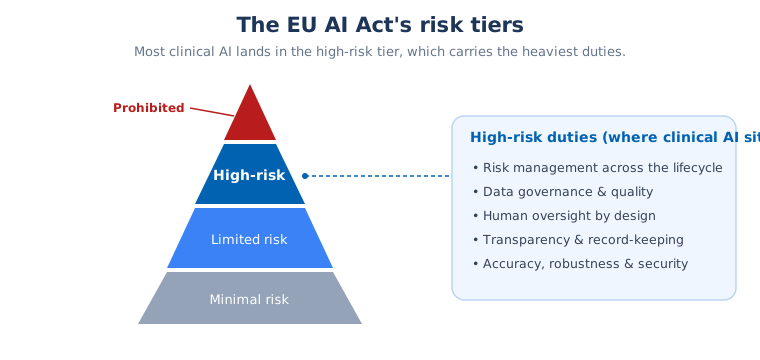
The AI Act sorts systems by risk: prohibited, high-risk, limited-risk, and minimal-risk, with obligations scaling accordingly. AI used in healthcare frequently lands in the high-risk category, particularly where a system is a safety component of a medical device or otherwise bears on health and safety.
High-risk classification triggers the law's most substantial requirements, which broadly include:
- Risk management across the system's lifecycle.
- Data governance covering the quality and relevance of training and input data.
- Technical documentation and record-keeping, including logging.
- Transparency so deployers understand the system's capabilities and limits.
- Human oversight designed into the system, not bolted on.
- Accuracy, robustness, and cybersecurity appropriate to the use.
Where exactly a given AI scribe falls depends on what it does. A tool that purely drafts documentation for clinician review sits differently than one marketed as influencing clinical decisions. That distinction, documentation assistance versus clinical decision support, is the same line regulators draw elsewhere, and it matters enormously for which obligations attach.
The themes that matter even if the Act never applies to you
Here is the practical point for a North American practice: even if your clinic is squarely outside the EU AI Act's jurisdiction, the law is shaping the global standard for what responsible clinical AI looks like. The themes it codifies are converging with what HIPAA, SOC 2, and good privacy practice already demand.
Human oversight. The Act's insistence that high-risk AI keep a human meaningfully in control is the same principle behind mandatory clinician review of AI-generated notes. A scribe built so a credentialed clinician reviews and signs every output is already aligned with this expectation.
Transparency about capabilities and limits. The Act wants deployers to understand what a system can and cannot do. For a buyer, that maps directly to demanding honest error rates and clear documentation from a vendor instead of accepting marketing accuracy claims at face value.
Data governance and record-keeping. Logging, traceability, and data quality requirements echo the audit trails and data-handling controls that a HIPAA-aligned platform should already have. A scribe that cannot tell you where your data goes or log who accessed it was never going to meet any of these standards.
The Act raises the floor globally, and that is good for buyers. The blunt version: a vendor that cannot pass the AI Act's documentation and oversight test cannot pass HIPAA's either. Same questions, different letterhead.
What this means for vendor selection
If you are choosing an AI scribe in 2026, the AI Act gives you a useful lens even outside Europe. Ask vendors:
- How is human oversight designed into the product? There should be no path where AI output reaches the record without clinician review.
- Can you document the system's accuracy and limitations? A vendor aligning with high-risk expectations can speak concretely about error rates, failure modes, and intended use.
- What logging and traceability exist? You should be able to see who accessed data and trace outputs back to their inputs.
- What is the system's intended-use classification, and does the marketing match it? A documentation tool marketed as a decision-maker invites a regulatory mismatch you do not want to inherit.
A vendor that handles these questions well is better positioned not just for the EU AI Act but for the broader regulatory direction every jurisdiction is moving toward.
For multinational and cross-border organizations
If your organization operates in the EU, or processes data of people in the EU, the analysis is more than academic and you should involve qualified counsel. The combination of the AI Act and the GDPR creates overlapping obligations, and the cross-border data flows common in cloud-based AI demand specific attention. This is exactly the kind of situation where a transfer impact assessment and a careful read of where processing happens are not optional.
For a single-site US clinic with no European footprint, the immediate legal exposure is limited. The strategic exposure is not: the tools you buy are being built to a standard the EU is helping define, and the vendors who ignore that direction are the ones least likely to age well.
The bottom line
Strip away the Brussels-specific detail and the AI Act asks four questions about any clinical AI: is a human meaningfully in control, can the vendor prove what the system does and does not do, is the data handled accountably, and does the marketing match the intended use. Those are not European questions. They are the same ones HIPAA, your malpractice carrier, and your patients are already asking. A vendor with good answers is ready for whichever jurisdiction writes the next rule. A vendor without them was a bad bet regardless of the AI Act.
Transcribe Health is built around human oversight, transparency, and auditable data handling. Read about our compliance approach or try it free.
This article is for informational purposes only and does not constitute legal or regulatory advice. The applicability of the EU AI Act, GDPR, HIPAA, or any other law to your organization depends on specific facts. Consult qualified counsel before making compliance determinations.
Articles connexes
The AI Scribe Shakeout: What Market Consolidation in 2026 Means for Your Practice
The AI medical scribe market is crowded and starting to consolidate. Here is how to protect your practice from betting on a vendor that gets acquired, pivots, or shuts down.
Industry TrendsHow CMS Documentation Requirements Are Changing
CMS is updating documentation requirements for Medicare and Medicaid. Here's what clinicians need to know about the changes and how AI can help.
Industry TrendsAI Medical Scribe Regulations: What's Coming in 2026 and Beyond
New regulations for AI medical scribes are on the horizon. Here's what physicians and vendors need to prepare for in 2026 and beyond.
Related Resources
Prêt à essayer la documentation propulsée par l'IA?
Rejoignez des milliers de professionnels de la santé qui économisent des heures chaque jour avec Transcribe Health.
Essai gratuit