
The AI Scribe Shakeout: What Market Consolidation in 2026 Means for Your Practice
The AI medical scribe market is crowded and starting to consolidate. Here is how to protect your practice from betting on a vendor that gets acquired, pivots, or shuts down.

By Fatih Aktas, Founder & CEO
Published

A gold rush always ends with a shakeout
AI scribe vendors are starting to disappear, get acquired, and reprice. If your practice has wired one into daily workflow, that is not an industry-watcher question. It is an operational risk that lands on your schedule.
It is easy to see why. A few years ago you could count the serious vendors on one hand; today there are dozens, from venture-backed startups to bolt-on features inside every major EHR. Crowded markets do not stay crowded. The same dynamics that funded a dozen competitors are now producing the next phase: acquisitions, pivots, quiet wind-downs, and a handful of survivors.
The good news is you can protect your practice from that churn without sitting on the sidelines while the technology pays for itself. It mostly comes down to how you choose.
Why consolidation is happening now
Three forces are squeezing the field at the same time.
The economics are hard. Running clinical-grade AI inference is expensive, and the per-visit price buyers will pay has fallen as competition intensified. Vendors that raised money on the promise of growth now have to show a path to actually making money on each customer. Not all of them can.
The EHRs entered the room. When the major EHR vendors ship their own ambient documentation, every independent scribe has to justify why a practice should buy a separate tool. Some have a clear answer (better accuracy, more specialties, lower cost, deeper integration). Some do not.
Capital got more cautious. The era of funding any AI company with a pulse is over. Investors now want efficiency and retention, which accelerates the gap between vendors who can stand alone and vendors who need to be acquired or shut down.
None of this means AI scribes are a bad bet. The technology is more useful than ever. It means the choice of which vendor is now a choice with real stakes.
What you actually lose when a vendor disappears
It helps to be concrete about the failure modes, because "the vendor got acquired" sounds harmless until you map it to your day.
- Your notes and audio. Where does your historical documentation live, and can you get it out in a usable format if the service ends?
- Your workflow. Staff trained on one interface, EHR integrations configured, templates tuned to your specialty. All of that has to be rebuilt on a replacement.
- Your data protections. A Business Associate Agreement is with a specific entity. An acquisition can change who controls your patients' protected health information and under what terms.
- Your pricing. Acquirers reprice. The deal that made the math work can change at renewal.
The point is not to be paranoid. It is to choose in a way that makes any of these outcomes survivable.
How to protect your practice
You cannot predict which vendors survive. You can choose so that you are fine either way. A short due-diligence checklist does most of the work.
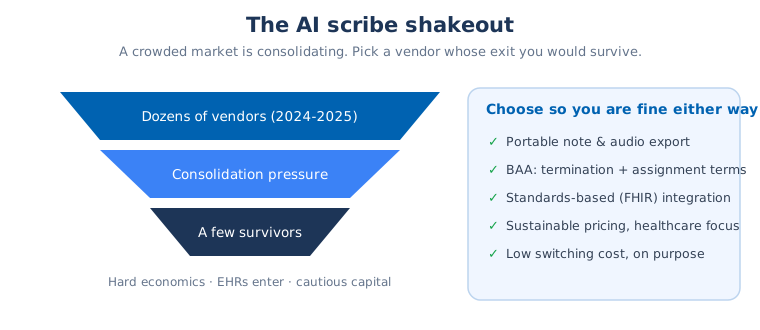
1. Demand a real data export, and test it. Before you commit, confirm you can export your notes and audio in a standard, portable format, and actually run the export during your trial. A vendor that makes your data easy to leave with is a vendor confident enough to keep you by being good, not by holding your records hostage.
2. Read the BAA's assignment and termination clauses. Look specifically at what happens to your data on termination and whether the agreement can be transferred to an acquirer without your consent. This is a privacy and compliance question, not just a commercial one.
3. Favor standards-based EHR integration. Integrations built on open standards (for example FHIR-based interfaces) are easier to recreate elsewhere than proprietary connectors. If switching vendors means rebuilding everything from zero, you are more locked in than you think.
4. Look for boring signs of durability. Does the vendor charge a sustainable price, or one that looks like it is buying market share at a loss? Is the company focused on healthcare specifically, or is medical scribing a side bet? Sustainable beats spectacular when you are trusting a vendor with your documentation for years.
5. Keep your switching cost low on purpose. The migration playbook for moving between scribe vendors is well understood. Knowing it is achievable, and choosing tools that keep it achievable, is your insurance policy.
Don't let the shakeout freeze you
Waiting for the market to settle carries its own cost: every month without an AI scribe is a month of after-hours charting and lost face time you do not get back. The technology already works and already pays for itself in most practices.
So pick a vendor the way you would pick any partner you intend to depend on: check that you can leave, check who controls your data, check that the business makes sense. The practices that get burned in a consolidation chose on a flashy demo and a low introductory price. The ones who come through fine treated portability and data control as features worth paying for.
Transcribe Health is built for the long term: portable note and audio exports, standards-based EHR integration, and a clear Business Associate Agreement. Compare your options or try it free.
This article is for informational purposes only and does not constitute legal, financial, or procurement advice. Evaluate any vendor's contractual terms, data-handling practices, and financial stability with appropriate professional guidance before committing.
Articles connexes
The EU AI Act Comes for Medical AI: What It Means for AI Scribes in North America
The EU AI Act's high-risk rules are phasing in, and they reach beyond Europe. Here is what the regulation says about clinical AI and why US and Canadian practices should pay attention.
Industry TrendsThe State of AI in Healthcare Documentation in 2026
Where AI healthcare documentation stands in 2026, from adoption rates to regulatory shifts and what clinicians should expect next.
Industry TrendsWill AI Replace Medical Scribes Entirely
AI scribes are changing healthcare documentation, but will they fully replace human medical scribes? An honest look at what's likely.
Prêt à essayer la documentation propulsée par l'IA?
Rejoignez des milliers de professionnels de la santé qui économisent des heures chaque jour avec Transcribe Health.
Essai gratuit