AI Medical Scribe Comparison 2026: A Side-by-Side Look at the Leading Tools
A factual, side-by-side comparison of the leading AI medical scribe platforms in 2026, pricing, EHR integration, specialty depth, compliance, and where each one actually fits.

By Fatih Aktas, Founder & CEO
Published

How to read this comparison
Every AI medical scribe vendor will tell you they're the best fit for your practice. That's the nature of sales. The honest reality is that the AI scribe market in 2026 has fragmented into clear categories, and the right choice depends entirely on what you're optimizing for.
This guide compares the leading platforms across the dimensions that actually move the needle: clinical accuracy, EHR integration depth, specialty coverage, compliance posture, and total cost of ownership. Where vendors publish hard numbers, we cite them. Where they don't, we say so. Marketing claims without independent verification are flagged.
The goal isn't to declare a winner. It's to help you skip three vendor demos by ruling out platforms that won't fit your practice before you start.
The category breakdown
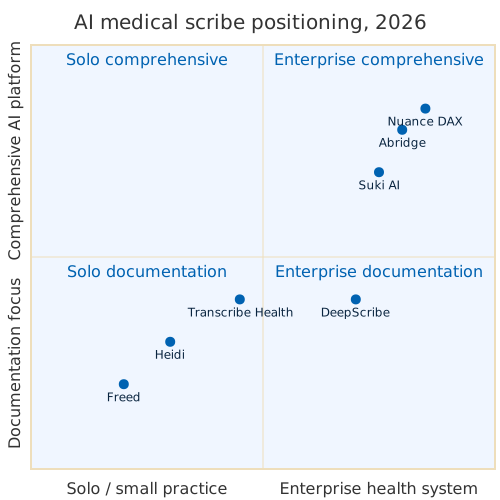
The market in 2026 splits roughly into four buckets:
Enterprise ambient platforms. Built for hospitals and large health systems. Deep EHR integration via formal partnerships. Six-figure annual contracts. Examples: Nuance DAX (Microsoft), Abridge.
Mid-market specialty-tuned platforms. Built for outpatient practices, multi-specialty groups, and ambulatory networks. Per-provider monthly pricing, transparent contracts. Examples: Transcribe Health, Suki, DeepScribe, Heidi Health.
Solo-and-small-practice tools. Built for independent providers. Self-serve onboarding, low monthly cost. Examples: Freed, Tali AI, Augmedix Live.
General-purpose dictation with AI assist. Older voice recognition platforms that added AI scribing. Still oriented around the dictate-and-edit workflow. Examples: Dragon Medical One, Suki Voice.
Choosing the wrong category is the most common mistake. A solo family physician doesn't need enterprise DAX. A 200-provider health system shouldn't be on a self-serve tool. Most of the dissatisfaction in AI scribe deployments traces back to a category mismatch, not a bad product.
The criteria that actually matter
Before the comparison table, here's why each criterion is weighted the way it is.
Clinical accuracy, not word accuracy. Vendors love to quote 98-99% word-level accuracy. That number is almost meaningless. What matters is whether the platform correctly captures medications and doses, diagnoses, follow-up plans, and red-flag findings. A platform that captures 99% of the words but misses an allergy mention is more dangerous than one that catches 97% of words including every drug name. Ask every vendor for medication capture rate and diagnosis attribution accuracy specifically.
Specialty depth. A general AI scribe trained on primary care will produce competent notes for primary care. Drop it into a complex orthopedic post-op visit or a psychiatry intake and the quality drops sharply. Platforms with specialty-trained models outperform general models by 15-30% on clinical accuracy in their target specialties.
EHR integration depth. There are real levels here:
- Copy-paste. The lowest tier. You paste text into your EHR. Friction city.
- Browser extension or simple paste. Marginally better. Note-level workflow only.
- API integration with one or two EHRs. Push-only typically. Better but limited.
- Bidirectional FHIR-based integration. Pulls patient context before the visit, pushes structured note + ICD codes + orders afterward. This is the gold standard.
The difference between copy-paste and bidirectional integration is 2-4 minutes per encounter. At 25 encounters per day, that's an hour of administrative time.
Compliance posture. Either a vendor signs a Business Associate Agreement or they don't. For Canadian practices, PIPEDA compliance and data residency in Canada matter. SOC 2 Type II is now table stakes, any vendor without it should be ruled out for serious clinical use.
Pricing transparency. Some vendors publish per-provider monthly pricing on their website. Others require sales calls to even get a starting price. Transparency is a proxy for sales-process friction over the full vendor relationship.
On-premise or private-cloud options. For health systems with strict data governance, the ability to deploy the AI scribe on customer infrastructure (rather than the vendor's multi-tenant cloud) is increasingly important. Most platforms are cloud-only.
The comparison
The table below summarizes published, verifiable facts as of early 2026. Where a vendor doesn't publish a fact, we mark it as "not disclosed" rather than guessing.
| Platform | Target market | Specialty models | EHR integration | Compliance | Public pricing | On-prem |
|---|---|---|---|---|---|---|
| Transcribe Health | Outpatient, multi-specialty groups | 25+ specialty models including IVF, allergy/immunology, PT, dentistry | Bidirectional FHIR + OSCAR EMR + Epic, Cerner via partner | HIPAA + PIPEDA + BAA; controls built to SOC 2 Trust Services Criteria | Yes, Solo $X/mo, Practice from $84/seat | Yes (Enterprise) |
| Nuance DAX (Microsoft) | Large hospitals, health systems | Yes, broad coverage | Deep Epic + Cerner integration | HIPAA + SOC 2 + BAA | No, enterprise sales only | Limited |
| Abridge | Health systems, payers | Broad coverage | Epic partnership, FHIR | HIPAA + SOC 2 + BAA | No, enterprise sales only | No |
| Suki AI | Outpatient, hospitals | Some specialty coverage | Epic, Cerner, Athena, others | HIPAA + SOC 2 + BAA | Per-provider, contact sales | No |
| DeepScribe | Outpatient | Some specialty coverage | Epic, Cerner, others via API | HIPAA + SOC 2 + BAA | Contact sales | No |
| Heidi Health | Outpatient, solo | General | Limited EHR integrations, growing | HIPAA + BAA (Aus + US) | Yes, free tier + paid | No |
| Freed AI | Solo practitioners | General | Copy-paste primarily | HIPAA + BAA | Yes, $99/mo | No |
| Dragon Medical One (Nuance) | Broad market | General + macros | Wide EHR support | HIPAA + BAA | Per-user enterprise | Yes (legacy) |
| Augmedix Live | Outpatient, hospitals | General | Epic, Cerner | HIPAA + BAA | Contact sales | No |
A few notes on what this table doesn't show:
The "specialty models" column is a binary check on whether the vendor publicly markets specialty-trained models. Marketing claims don't always match reality, a vendor saying "we work for all specialties" without specifics is often a generic model with a dropdown. The platforms that name and document their specialty coverage tend to deliver more consistent results in those specialties.
The "EHR integration" column captures depth, not coverage. A platform with deep Epic integration is more useful to an Epic shop than one with shallow integration across 10 EHRs.
"On-prem" matters mostly for Canadian and European health systems with data residency requirements, and for US health systems with internal data governance policies that ban third-party cloud processing of ePHI.
Where each platform actually fits best
The choice isn't really "which is best", it's "which fits my situation."
Solo or small practice (1-5 providers), self-serve, low budget. Freed, Heidi (free tier), or Transcribe Health Solo. The decision usually comes down to specialty coverage and EHR integration. If you use OSCAR EMR or another non-mainstream EHR, Transcribe Health's broader integration coverage tends to matter more than the slightly higher price.
Mid-size outpatient group (10-50 providers). Transcribe Health, Suki, DeepScribe. Decision criteria here are usually:
- Specialty coverage matching your actual mix
- Whether your EHR has a deep integration partnership
- Whether you need PIPEDA compliance and Canadian data residency
- Pricing structure (per-seat with month-to-month vs. annual commitment)
For Canadian practices, the data residency question often narrows the field substantially. Most US-headquartered vendors store and process data in the US, which can create PIPEDA and provincial compliance issues.
Large health system, hospital, or academic medical center. Nuance DAX, Abridge, or Augmedix. These are the only platforms operating at the scale and integration depth that hospital IT requires. Pricing is enterprise, integration projects take months, and the platforms are tightly coupled to Epic or Cerner.
Specialty practice with unusual requirements. For fertility clinics, allergy and immunology, physical therapy, or other specialties with non-standard note formats, the platforms with explicit specialty models substantially outperform general platforms. This is where Transcribe Health, DeepScribe, and Suki tend to differentiate from the broader market.
Voice-dictation-first workflow. If your providers are already heavy Dragon users and want AI summaries on top of their dictation workflow, Dragon Medical One with the newer AI features is the natural upgrade path. Switching to an ambient-listening platform requires a workflow change that some providers actively resist.
Questions to ask every vendor
The demo is designed to show the best case. These questions expose the gaps that demos hide. Run them on every vendor on your shortlist.
On accuracy and quality:
- What is your medication capture rate, specifically for my specialty?
- How does the platform handle complex visits with multiple problems and medical decision-making?
- Can you share clinical accuracy benchmarks from independent customer audits (not vendor-reported numbers)?
- How do you handle multi-language encounters?
On integration:
- What level of integration do you have with my EHR? Push-only, pull-only, or bidirectional?
- Do you pull patient context (problem list, medications, allergies) before the visit?
- Do you push structured note + ICD-10 + CPT suggestions back, or just plain text?
- What is the average implementation time for my EHR?
On compliance:
- Can I see your most recent SOC 2 Type II report?
- Where is patient data stored and processed geographically?
- Do you sign a BAA without modification, or do you require amendments?
- What's your data retention and deletion policy?
- For Canadian customers: where does the data physically reside, and do you meet provincial residency requirements like Quebec Law 25?
On pricing and contracts:
- What's the all-in per-provider monthly cost, including any setup, training, or integration fees?
- What's the contract term and cancellation policy?
- How is the price affected by seat changes mid-contract?
- Are there usage-based fees (per-minute, per-note) on top of the per-provider price?
On the relationship:
- Who is my point of contact after implementation?
- What's your average response time for support tickets?
- How often do you push platform updates, and how is that communicated?
- Can I get references from customers in my specialty and at my size?
What the leaderboard misses
Comparison tables compress nuance. A few things the table above doesn't capture but that often decide deployments:
Provider experience. The AI scribe runs in the background of every patient encounter. If providers find it intrusive, slow, or unreliable, they'll stop using it. The product UX, mobile app quality, and recovery from errors (mis-transcriptions, missed audio) determines whether the deployment succeeds.
The note quality versus your note style. Each provider has a documentation style they've refined over years. A platform that produces structurally different notes than your norm will feel wrong even if it's technically accurate. The best vendors customize note templates to your existing style; the worst force you into their default format.
The vendor's roadmap. AI scribing is moving fast. A platform that's barely keeping up today will be far behind in 18 months. Ask about the roadmap, not just features, but the rate of model improvements, EHR partnerships, and specialty coverage expansion.
Customer concentration. Some vendors get most of their revenue from a few large customers, which means smaller customers get less attention. Others have diversified bases. This is hard to assess from outside but worth probing during reference calls.
How to run your evaluation
The pattern that works for most practices:
- Pre-screen. Use the table above to rule out 60% of the market based on category fit.
- Three demos. Pick three platforms in the right category for your practice.
- Trial the top two. Run the platforms in parallel for 2-4 weeks on real encounters, with the same providers, in the same specialty mix.
- Compare side-by-side. Compare the notes from the same encounter on each platform. The differences become obvious within a week.
- Decide on data, not impressions. Document medication capture accuracy, time-to-final-note, and provider satisfaction scores. The decision should be driven by these numbers, not the vendor's pitch.
Most practices that follow this process end up with a clearly better platform, and they make the decision in three to four weeks instead of three to four months.
A note on this comparison
We make Transcribe Health, so this comparison isn't neutral in the sense that we'd benefit from you choosing us. We've tried to make it accurate and useful regardless. Where competitors do something better than us, we've said so. Where the choice depends on your situation, we've explained the criteria so you can decide for yourself.
If you'd like to see Transcribe Health in your specialty and your EHR, the pricing page has plans for solo providers through enterprise, with a free trial that doesn't require a credit card. If we're not the right fit, the questions above will help you find the platform that is.
Articles connexes
Best AI Medical Scribe Software in 2026: How to Choose
A practical guide to evaluating AI medical scribe platforms in 2026, covering the features, questions, and trial strategies that actually matter.
AI TechnologyFrom Ambient to Agentic: How AI Scribes Are Starting to Do More Than Document
AI scribes are moving from passively transcribing visits to drafting orders, referrals, and follow-ups. Here is what agentic documentation means for clinicians and where the guardrails sit.
AI TechnologyVoice Recognition vs AI Scribe: Why Dictation Software Isn't Enough
Compare traditional voice recognition dictation with AI medical scribes. Learn why dictation software falls short for clinical documentation.
Prêt à essayer la documentation propulsée par l'IA?
Rejoignez des milliers de professionnels de la santé qui économisent des heures chaque jour avec Transcribe Health.
Essai gratuit