
AI Scribes in Community Health Centers and FQHCs
Federally qualified health centers carry heavy documentation and reporting burdens on thin budgets. Here is how AI scribes fit the FQHC model, from UDS reporting to high-volume, multi-language visits.

By Fatih Aktas, Founder & CEO
Published

The hardest documentation job in healthcare, on the tightest budget
Federally qualified health centers and community health centers do some of the most demanding work in medicine. They serve patients with complex social and clinical needs, often across language barriers, at high volume, with a workforce that is chronically stretched. And they do it while carrying a reporting burden, the Uniform Data System chief among it, that most private practices never touch.
That combination, heavy documentation plus heavy reporting plus thin margins, makes the safety net both the place where an AI scribe could help most and the place where the budget objection is loudest. This article looks honestly at both sides: where ambient documentation genuinely fits the FQHC model, and where the practical realities deserve a clear-eyed answer.
Why the documentation burden is heavier here
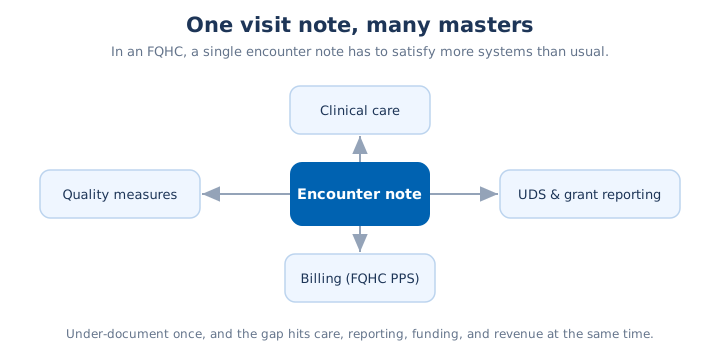
A community health center visit is rarely simple. The patient may have several chronic conditions, unaddressed social drivers of health, and a history that spans multiple systems. The clinician is often working against the clock to see enough patients to keep the doors open. And the documentation has to serve more masters than usual:
- Clinical care, the same complete, accurate note every visit requires.
- UDS and grant reporting, which depends on structured data captured consistently across the center.
- Quality measures tied to funding and to the center's mission.
- Billing, including the specific mechanics of FQHC reimbursement.
When one note has to feed all of that, under-documentation is not just a quality problem. It is a reporting and funding problem. And the clinician absorbing the burden is frequently the same one already at risk of burnout in an environment that cannot easily backfill an empty chair.
Where an AI scribe fits the FQHC model
Ambient documentation addresses several pain points that are especially acute in community health.
It protects clinician time at high volume. The core benefit of an AI scribe, removing the typing and the after-hours charting, scales with visit volume. A clinic running a packed schedule recovers more total time than a low-volume practice, simply because there are more encounters to document.
It supports multi-language encounters. Community health centers serve linguistically diverse populations, and visits frequently involve interpreters. Documentation tools that handle multiple languages and interpreted conversations fit this reality far better than English-only tools. We have written separately about documenting visits with limited-English-proficiency patients; for many FQHCs that is not an edge case, it is Tuesday.
It improves data consistency for reporting. Structured, consistent notes across many clinicians make downstream reporting less painful. When documentation captures the same clinical elements the same way, the data that feeds UDS and quality measures is cleaner at the source.
It helps retention in a workforce you cannot afford to lose. Burnout-driven turnover is brutally expensive for a safety-net organization. Anything that gives clinicians their evenings back is a retention investment, not just a convenience.
The budget objection, taken seriously
It would be dishonest to write this without addressing cost head-on. FQHCs do not have spare money, and "the ROI works" is easy to say and harder to feel when every dollar is committed.
A few honest points:
The math is driven by time, and time is the scarcest resource here. The return on an AI scribe comes from recovered clinician hours, which convert into either capacity or sustainability. In a setting where every clinician hour is precious and the workforce is thin, that recovered time is worth more, not less.
Pricing has come down. The competitive pressure reshaping the AI scribe market has pushed prices to levels that put adoption within reach of organizations that could not have justified it a couple of years ago. The per-provider cost that blocked safety-net adoption early on is not the cost today.
Grant and quality-improvement funding can apply. Documentation tools that improve reporting accuracy and clinician retention can fit within quality-improvement or operational-improvement funding rather than coming purely out of clinical margin. The framing matters when you make the internal case.
Start with a pilot, not a leap. The right move is rarely a center-wide rollout on day one. A small pilot with a few willing clinicians produces real numbers, time saved, notes completed during clinic hours, clinician sentiment, that make or break the broader decision on evidence rather than hope.
None of this makes cost a non-issue. It makes it a question to evaluate with real data rather than dismiss on reflex.
The compliance dimension is non-negotiable
Community health centers handle protected health information for a particularly vulnerable population, which raises the stakes on getting the privacy and security pieces right. Any AI scribe in this setting needs the same fundamentals that apply anywhere: a Business Associate Agreement, encryption, access logging, and a clear answer to where patient data goes. The vulnerability of the population served is a reason to hold the bar higher, not an excuse to cut corners on cost.
The good news is that these requirements are not in tension with the FQHC budget. A properly built, HIPAA-aligned platform is the baseline expectation for any vendor worth considering, and it does not carry a premium for being compliant. Compliance is the price of entry, not an upsell.
Getting it right
A pilot with a few willing clinicians settles most of the question: measure time saved and notes finished inside clinic hours, and you have real numbers instead of a vendor's promise. Two checks are specific to this setting and easy to skip. Confirm the multi-language support matches your actual patient population rather than a marketing list, and confirm the documentation feeds UDS and quality reporting cleanly rather than complicating it. The compliance fundamentals, a BAA, encryption, and audit logging, are non-negotiable before any patient data flows, and the financial case is strongest built on your own pilot data rather than a vendor's ROI calculator.
The safety net runs on the dedication of people doing hard work with too few resources. An AI scribe will not fix the structural pressures of community health. But by taking the documentation load off clinicians who are already carrying too much, it can give back the one resource these organizations can never buy more of: their people's time.
Transcribe Health supports high-volume, multi-language documentation on HIPAA-aligned infrastructure, with pricing built for practices of every size. See plans and pricing or try it free.
This article is for informational purposes only and does not constitute legal, financial, or compliance advice. Reporting, reimbursement, and funding rules for FQHCs are specific and change over time; verify requirements with appropriate guidance before making operational decisions.
Articles connexes
How to Choose an AI Medical Scribe for Your Specialty
Not all AI scribes handle every specialty equally. Learn what to look for when choosing an AI scribe that understands your specific clinical workflow, terminology, and documentation requirements.
Practice ManagementHow AI Scribes Integrate with OSCAR EMR
OSCAR EMR is one of Canada's most popular open-source electronic medical records. Learn how AI scribe integration works with OSCAR to streamline clinical documentation for Canadian physicians.
Practice ManagementAI Medical Scribe vs Human Scribe: Which Is Better for Your Practice?
Compare AI and human medical scribes across cost, accuracy, scalability, and workflow fit to find the right option for your practice.
Related Resources
Prêt à essayer la documentation propulsée par l'IA?
Rejoignez des milliers de professionnels de la santé qui économisent des heures chaque jour avec Transcribe Health.
Essai gratuit