Medical Transcription in 2026: The Complete Guide for Modern Practices
How medical transcription works in 2026, where AI scribes beat (and still lose to) human transcriptionists, what accuracy and cost to expect, and the HIPAA and PIPEDA rules every practice needs to know before buying.

By Fatih Aktas, Founder & CEO
Published

What medical transcription means today
Medical transcription used to be a job title. A person sat at a desk, listened to recorded provider dictations, and typed them into patient charts. In 2026, "medical transcription" describes a category of software, usually AI-powered, that converts spoken clinical conversations into structured documentation in real time.
The shift matters because the tradeoffs are completely different. Human medical transcriptionists were slow, expensive, and prone to backlogs, but they understood clinical context. Early speech-recognition systems were fast and cheap but produced unreliable output that required heavy editing. Modern AI medical transcription tries to combine the speed and cost of automation with the clinical understanding of a human transcriptionist, and in 2026, for the first time, the technology is genuinely good enough to do that for most use cases.
This guide explains how we got here, how the technology works, where it succeeds and fails, and how to evaluate a platform if you're shopping for one.
A short history of medical transcription
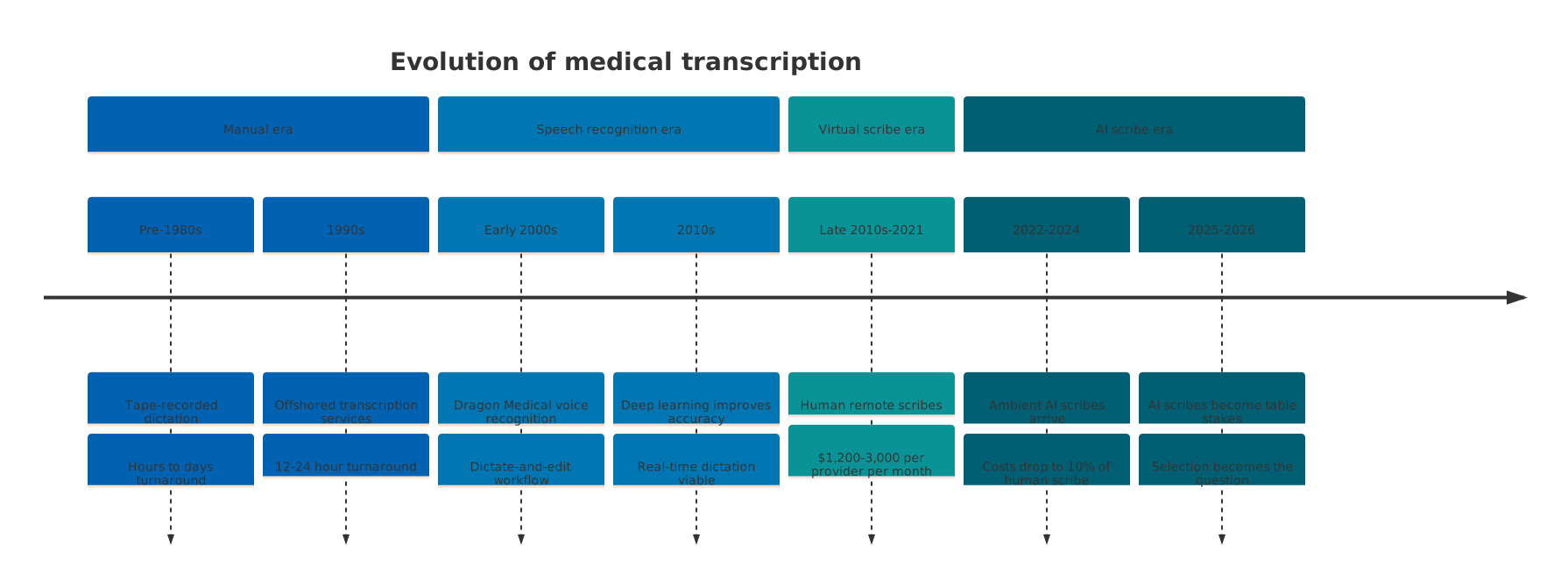
Pre-1980s. Doctors dictated notes onto tape recorders. Transcription was done in-house or sent to a transcription service. Turnaround time: hours to days. Cost: roughly $0.10 per line.
1990s. Dictation services moved offshore for cost. Transcription quality varied widely. Turnaround improved to 12-24 hours. Some hospitals had their own transcription pools.
Early 2000s. Voice recognition systems like Dragon Medical entered the market. Providers dictated directly into their EHR, with the software typing as they spoke. Required heavy training, careful enunciation, and constant correction. Adoption was limited.
2010s. Speech recognition accuracy improved with the rise of deep learning. Dictation-and-edit workflows became viable for some providers. But the workflow still required dictating in clinical shorthand, providers couldn't just talk naturally.
Late 2010s to early 2020s. "Virtual scribe" services emerged. A human in a remote location listened to encounters in real time and typed notes. Quality was good but costs were high, typically $1,200-3,000 per provider per month.
2022-2024. Ambient AI scribes arrived. Large language models, fine-tuned on medical conversations, could generate structured clinical notes from natural provider-patient dialogue. Quality jumped sharply year over year. Costs dropped to roughly 10% of human-scribe pricing.
2025-2026. AI scribes became table stakes for outpatient practices. The remaining questions are no longer "does it work" but "which platform fits my workflow, my specialty, and my compliance requirements."
How AI medical transcription works in 2026
The pipeline behind a modern AI medical scribe involves five distinct technologies working in sequence. Understanding the pipeline helps you evaluate where a platform might fall short.
Stage 1: Audio capture. A microphone, in the exam room, on a phone, or built into a telehealth platform, captures the encounter audio. Better platforms support multiple microphone modes (ambient room mic, lapel mic, smartphone) and handle background noise, overlapping speech, and accents.
Stage 2: Speech recognition. Raw audio becomes raw text. Modern systems use medical-domain-tuned acoustic models that recognize clinical vocabulary, drug names, anatomical terms, and abbreviations. Top-tier systems achieve 96-98% word-level accuracy on clean audio in primary care, and somewhat lower on complex specialty encounters or noisy environments.
Stage 3: Speaker diarization. The system identifies who said what. Provider speech is tagged separately from patient speech, family-member speech, and any third-party voices. Good diarization is what allows the chief complaint to be attributed correctly and the assessment to come from the provider.
Stage 4: Clinical NLP. Natural language processing, which we cover in depth in how NLP powers clinical documentation, extracts medical entities (medications, dosages, diagnoses, symptoms, procedures), maps relationships between them, and infers clinical context that wasn't explicitly stated.
Stage 5: Note generation. A large language model, fine-tuned on clinical documentation, organizes the extracted information into the appropriate sections of a clinical note. SOAP notes, problem-oriented notes, specialty-specific templates, all become possible because the model understands both the content and the structure of medical documentation.
The whole pipeline runs in under 60 seconds for a typical 15-minute encounter. The provider finishes the visit, walks to the next room, and a draft note is waiting for review.
Real-time versus post-visit transcription
There's a meaningful split in the market between platforms that transcribe in real time versus those that process the audio after the visit.
Real-time transcription generates the note as the encounter happens. The provider can see the transcript building during the visit, catch any errors immediately, and have a draft ready the moment the patient leaves. The downside is higher computational cost and slightly lower accuracy on complex passages.
Post-visit transcription records the encounter and processes it after. The provider waits 1-5 minutes for the note to appear. Accuracy is typically slightly higher because the model can take more compute time and use bidirectional context. The downside is the wait, and the lost opportunity to catch errors live.
For most outpatient practices, real-time is the better choice. The time savings compound over a day, and the ability to catch a missed medication mention while the patient is still in the room matters. We cover the tradeoffs in more detail in real-time versus post-visit medical transcription.
What accuracy actually looks like in 2026
Vendor accuracy claims should be treated with skepticism. Marketing teams quote whatever number sounds best. The numbers that matter, with realistic ranges from independent audits of top platforms:
- Word-level accuracy: 96-98% on clean primary care audio, 92-96% on noisy or specialty audio
- Medication capture rate: 92-97%, every drug name, dose, frequency, and route correctly captured
- Diagnosis attribution: 88-94%, diagnoses attributed to the correct visit and patient
- Section placement accuracy: 90-95%, information placed in the correct SOAP section (Subjective, Objective, Assessment, Plan)
- Plan capture rate: 89-94%, follow-up plans, referrals, and patient instructions correctly captured
Notice what these numbers mean in practice: an AI transcript is a high-quality draft that requires physician review, not a finished document. The point of physician review isn't to fix typos, it's to verify the clinical content matches the encounter. Skip the review step and you've reintroduced documentation risk that AI was supposed to reduce.
We go deeper into accuracy benchmarks and what they mean for liability in AI medical transcription accuracy.
The compliance landscape
Medical transcription touches protected health information at every stage, audio capture, speech recognition, NLP processing, note storage. The compliance requirements vary by jurisdiction and use case.
United States: HIPAA. Any vendor that processes ePHI on your behalf is a business associate and must sign a Business Associate Agreement (BAA). HIPAA compliance requires encryption at rest and in transit, access controls, audit logging, breach notification procedures, and a risk assessment. SOC 2 Type II is now the de facto evidence layer; any vendor without it should be ruled out.
Canada: PIPEDA, provincial laws. PIPEDA is the federal baseline. Provincial laws stack on top: PHIPA in Ontario, Quebec Law 25, Alberta PIPA, BC PIPA. Canadian practices generally need data residency in Canada, explicit patient consent, and provider-side restrictions on cross-border data flows.
Europe: GDPR. GDPR applies if you're processing data of EU residents. Data residency in the EU, Data Processing Agreements (DPAs), and Data Protection Impact Assessments (DPIAs) for high-risk processing are required.
Patient consent. Most jurisdictions require some form of patient consent before recording an encounter. Some are explicit (Quebec Law 25), some are implied (most US states for one-party consent). We cover the state-by-state map in patient consent for AI medical scribe recording.
Data storage and retention. Where the data physically resides matters. So does how long it's kept. Some vendors keep audio recordings indefinitely; others delete them after note generation. Both approaches are valid for different reasons, but you should know which your vendor does.
A vendor that can't answer these questions clearly is a vendor that hasn't thought through their compliance posture, which is itself a risk signal.
Specialty-specific considerations
A general AI medical transcription platform trained on primary care will produce competent notes for primary care. Drop it into orthopedic surgery, allergy and immunology, IVF and fertility, or psychiatry, and the quality drops noticeably.
The reason is straightforward. Each specialty has its own vocabulary, its own note conventions, and its own clinical reasoning patterns. A model trained mostly on general medical conversations doesn't know that "BNP" is meaningful in heart failure encounters or that "ICSI vs. conventional" is meaningful in IVF cycles. Specialty-trained models, fine-tuned on encounter data from that specialty, perform 15-30% better on the metrics that matter.
When you evaluate platforms, ask specifically:
- Do you have a model trained on my specialty?
- How many encounter hours did you train it on?
- Can you share accuracy benchmarks for my specialty specifically, not just overall numbers?
Generic answers ("we work for all specialties") usually mean a generic model.
EHR integration: the workflow multiplier
Even a perfect AI transcript is only as useful as your ability to get it into the patient chart. Integration depth determines whether the AI scribe saves you 2 minutes per visit or 5.
Tier 1: Copy-paste. The provider copies the AI-generated note from the scribe app and pastes it into the EHR encounter. Saves the typing time but no other workflow friction is removed.
Tier 2: Browser extension or direct paste. The scribe app integrates with the EHR's note field. The provider clicks a button and the note appears in the right field. Saves clicks but no other context flows.
Tier 3: API integration. The scribe pushes structured data (note text, ICD codes, CPT suggestions, follow-up tasks) into the EHR via API. Multiple fields populate automatically.
Tier 4: Bidirectional FHIR integration. The scribe pulls patient context (problem list, medications, allergies, recent labs) from the EHR before the visit, so the AI has clinical context during the encounter. After the visit, it pushes the structured note and any new clinical data back to the EHR. This is the gold standard, and the only level that meaningfully changes the workflow.
The difference between Tier 1 and Tier 4 is 2-4 minutes per encounter. Over a 25-patient day, that's an hour. Over a year of clinical work, that's roughly 200 hours. Integration depth, more than any other single factor, determines whether a deployment is worth the cost.
For practices on OSCAR EMR, we cover the integration patterns in AI scribe for OSCAR EMR. For Epic, Cerner, and other major EHRs, the depth varies by vendor, ask for a specific integration demo on your EHR before signing.
The total cost of AI medical transcription
Per-provider pricing in 2026 ranges from about $99/month at the low end (Freed, free tiers of Heidi) to $300-500/month for mid-market platforms (Transcribe Health, Suki, DeepScribe) to undisclosed enterprise pricing for hospital-grade platforms (Nuance DAX, Abridge).
The right way to think about cost isn't the monthly per-provider price, it's the total cost of ownership relative to the value created. We cover the math in detail in AI medical scribe pricing and cost of AI scribe versus hiring staff, but the rough framing:
- A provider seeing 25 patients a day, saving 2-3 minutes per encounter on documentation, gets back ~60 minutes a day
- At an average provider hourly value of $250-400, that's $250-400 of recovered productivity per day, per provider
- A $300/month AI scribe costs $14/day per provider
- The ROI is roughly 18-28x for the saved time alone, before counting any quality, burnout, or compliance benefits
The math is so strongly positive for most outpatient practices that the question isn't "can we afford an AI scribe", it's "can we afford to keep doing documentation the old way."
When AI medical transcription doesn't fit
In the interest of honesty: there are situations where AI medical transcription isn't the right answer in 2026.
Very specialized inpatient documentation. Complex hospital documentation with extensive interdisciplinary input, lengthy progress notes spanning multiple shifts, and dense clinical reasoning still favors human scribes or structured templates in many cases.
Highly variable encounter formats. Practices where each visit has wildly different structure, some 5-minute follow-ups, some 90-minute consultations, some procedure visits, see lower AI consistency than practices with more standardized encounter types.
Patients with severe speech or language barriers. Heavy accents, severe speech impediments, and certain language combinations still degrade AI accuracy meaningfully. We cover the multi-language angle in multi-language AI medical transcription.
Practices unwilling to do review. AI medical transcription requires physician review of the generated note before it goes into the chart. Practices that want a fully autonomous system that never needs review aren't ready for the technology yet, and probably won't be for another 3-5 years.
Provider workflows that depend on dictation muscle memory. Some providers have spent 20 years dictating clinical notes and have a refined personal style. Switching to ambient AI requires giving up that workflow. A dictation-plus-AI hybrid like Dragon Medical One is sometimes the better fit for these providers.
What to do next
If you've never tried an AI medical scribe, the path is straightforward:
- Pick three platforms based on the category your practice fits. Solo and small practices should look at Transcribe Health Solo, Freed, or Heidi. Mid-market should evaluate Transcribe Health Practice, Suki, and DeepScribe. Large systems should look at Nuance DAX, Abridge, and Augmedix.
- Trial the top two on real encounters for 2-4 weeks. Use the same providers and the same specialty mix on both platforms.
- Decide on data. Document accuracy, time-to-final-note, and provider satisfaction. Pick the platform that scores best on the metrics that matter to your practice.
For a side-by-side comparison of the leading platforms, see our AI medical scribe comparison for 2026.
If you'd like to see Transcribe Health on your own encounters, the pricing page has plans for every practice size and a no-credit-card trial. We're happy to help you evaluate even if you ultimately choose another platform, the wrong choice for your practice is bad for both of us.
Frequently asked questions
- What is medical transcription in 2026?
- Medical transcription used to be a job title: a person who listened to recorded dictations and typed them into charts. In 2026 the term describes a category of software, usually AI-powered, that converts spoken clinical conversations into structured documentation in real time. The provider talks naturally during the visit and a draft note is ready within about a minute of the encounter ending.
- What is the difference between medical transcription and an AI scribe?
- They increasingly mean the same thing. Traditional transcription turned dictated audio into plain text that a provider still had to organize. A modern AI scribe runs a five-stage pipeline (audio capture, speech recognition, speaker diarization, clinical NLP, and note generation) that produces a structured SOAP or specialty note from an ordinary provider-patient conversation, not just a raw transcript.
- Is medical transcription being replaced by AI?
- The human-transcriptionist role has largely been replaced for outpatient work. Ambient AI scribes now cost roughly 10% of human-scribe pricing and have become table stakes for outpatient practices. Human scribes still fit some cases: complex inpatient documentation, highly variable encounter formats, and patients with severe speech or language barriers. AI is not yet a fully autonomous replacement, since every note still needs physician review.
- How much does AI medical transcription cost?
- In 2026, per-provider pricing runs from about $99 a month at the low end, $300-500 a month for mid-market platforms, and undisclosed enterprise pricing for hospital-grade systems. The number that matters is total cost of ownership against value created: a $300 plan costs about $14 a day per provider, against 2-3 minutes saved per encounter that add up to roughly an hour of recovered time a day.
- How accurate is AI medical transcription?
- Independent audits of top platforms show word-level accuracy of 96-98% on clean primary care audio and 92-96% on noisy or specialty audio, with medication capture around 92-97%. That makes an AI transcript a high-quality draft, not a finished document. Physician review is mandatory, and its job is to confirm the clinical content matches the encounter, not to fix typos.
- Is AI medical transcription HIPAA compliant, and where is patient data stored?
- Any vendor processing ePHI on your behalf is a business associate and must sign a BAA; look for SOC 2 Type II, encryption, access controls, and audit logging behind it. Transcribe Health signs a BAA on every plan, never uses patient data to train AI models, and defaults to Canadian data residency. Always confirm where a vendor stores audio and text and how long it is kept.
Related Articles
From Ambient to Agentic: How AI Scribes Are Starting to Do More Than Document
AI scribes are moving from passively transcribing visits to drafting orders, referrals, and follow-ups. Here is what agentic documentation means for clinicians and where the guardrails sit.
AI TechnologyBeyond the Transcript: How Multimodal AI Scribes Are Learning to Capture the Exam
Most AI scribes only hear the visit. Multimodal documentation adds vision and structured data to capture what the conversation alone misses, and it raises new privacy questions worth understanding.
AI TechnologyAI Medical Scribe Comparison 2026: A Side-by-Side Look at the Leading Tools
A factual, side-by-side comparison of the leading AI medical scribe platforms in 2026, pricing, EHR integration, specialty depth, compliance, and where each one actually fits.
Ready to Try AI-Powered Documentation?
Join thousands of healthcare providers saving hours every day with Transcribe Health.
Start Free Trial