Clinical NLP Accuracy Benchmarks: What the 2026 Numbers Actually Mean
An honest look at clinical NLP accuracy benchmarks in 2026, what vendors measure, what those numbers really mean for patient safety, and how to evaluate them.

By Fatih Aktas, Founder & CEO
Published

The accuracy number that doesn't matter
When an AI medical scribe vendor tells you their platform is "98% accurate," your first question should be: 98% accurate at what, exactly?
Word-level accuracy, the percentage of spoken words the system correctly transcribes, is the number vendors love to quote. It's also the least clinically meaningful metric available. A system that correctly transcribes 98 of 100 words in a 15-minute encounter has missed 2 words. If those 2 words are "no" and "denied" in front of "chest pain," the system has converted a negative finding into a positive one, with potential downstream consequences ranging from unnecessary workup to misdiagnosis.
This article walks through the accuracy benchmarks that actually matter in 2026 for clinical natural language processing, what realistic ranges look like, and how to evaluate vendor claims.
If you're new to how the underlying technology works, our explanation of how NLP powers clinical documentation is the right starting point. This article assumes that foundation and goes deeper into accuracy specifically.
The seven accuracy dimensions
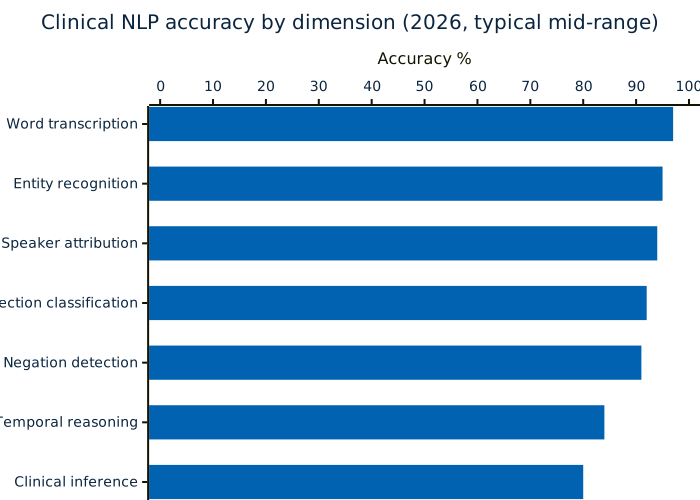
Clinical NLP isn't a single capability, it's a pipeline of distinct tasks, each with its own accuracy profile. A well-performing system has to do all seven reasonably well. A system that excels at one and fails at another isn't safe to deploy.
Dimension 1: Word-level transcription. Speech-to-text accuracy on raw words. The headline number. Realistic ranges in 2026: 96-98% on clean primary care audio, 92-96% on specialty or noisy audio.
Dimension 2: Medical entity recognition. Identifying medications, dosages, diagnoses, symptoms, body parts, and procedures within the transcribed text. Realistic range: 93-97% for common entities, 85-93% for rare or specialty-specific entities.
Dimension 3: Negation and uncertainty detection. Distinguishing "patient reports chest pain" from "patient denies chest pain" from "patient with possible chest pain." Realistic range: 88-94% in 2026. This is harder than it looks and is one of the most common sources of clinical misinterpretation.
Dimension 4: Speaker attribution. Tagging which utterances came from the provider, the patient, a family member, or others in the room. Realistic range: 92-97% for two-speaker encounters, 80-90% for three-or-more-speaker encounters.
Dimension 5: Temporal reasoning. Constructing a timeline from relative time references ("three weeks ago," "since last visit," "before the procedure"). Realistic range: 80-88%. This is one of the weakest areas of clinical NLP in 2026 and an active research focus.
Dimension 6: Section classification. Placing extracted information in the correct section of a clinical note. Realistic range: 90-95% for SOAP-style notes, slightly lower for specialty-specific note formats.
Dimension 7: Clinical inference. Filling in clinical context that wasn't explicitly stated, recognizing that an HbA1c discussion implies diabetes care, or that "ACEi" refers to ACE inhibitors. Realistic range: 75-85%. This is where the biggest variation between platforms shows up.
A good way to evaluate a vendor's accuracy claims is to ask them to break down their numbers across these seven dimensions. Vendors that quote a single "98% accurate" number without breaking it down are either being deliberately vague or don't measure their system properly.
Where the dangerous errors hide
Not all errors are created equal. A clinical NLP system can be 96% accurate overall while having an unacceptable error rate in the categories that matter most for patient safety.
The errors that most often cause clinical harm:
Medication errors. Wrong drug, wrong dose, wrong frequency, wrong route. Realistic medication capture accuracy in 2026 is 92-97%, which sounds high until you realize that a practice doing 100 medication mentions per day will produce 3-8 medication errors per day if not caught in review. The implications for prescribing safety, allergy reconciliation, and renewal accuracy are direct.
Allergy attribution errors. Confusing the patient's allergies with someone else's, or missing an allergy mention entirely. These errors are rarer than medication errors but more dangerous when they happen.
Negated symptom errors. As mentioned above, converting "patient denies suicidal ideation" into "patient reports suicidal ideation", or vice versa. The clinical and medico-legal implications are obvious.
Wrong-side errors. "Left knee" transcribed as "right knee," or "left ear" as "right ear." Surgical encounters with side-specific findings are particularly vulnerable. NLP systems should flag laterality mentions for explicit review.
Dose magnitude errors. "10 milligrams" transcribed as "10 grams," or "10 micrograms" as "10 milligrams." Off-by-three-orders-of-magnitude errors in dose transcription are rare but catastrophic.
A well-designed clinical NLP platform doesn't just optimize for overall accuracy, it specifically targets these high-consequence error categories with additional safeguards. Some examples:
- Confidence thresholds on medications. When the system isn't certain about a medication name or dose, it flags the entry for explicit provider review rather than guessing.
- Cross-checks against the patient's medication list. A drug name that doesn't match anything currently prescribed or commonly prescribed for the patient's condition gets flagged.
- Allergy reconciliation prompts. When a new medication is mentioned, the system checks it against documented allergies and warns of potential conflicts.
- Laterality verification. Side-specific findings prompt the provider to confirm laterality before the note is finalized.
When you evaluate vendors, ask specifically what safeguards they have for these high-risk categories. Vendors that haven't thought through these scenarios are vendors whose deployments will eventually produce a sentinel event.
Benchmark datasets and why they're misleading
Independent clinical NLP benchmarks do exist, i2b2/n2c2 challenges, MIMIC-derived datasets, MedNLI for natural language inference, but they have limitations that affect how their numbers translate to real-world deployment.
The benchmark data is older than the systems. Most standard clinical NLP benchmarks were assembled from data 5-15 years old. The vocabulary, drug names, treatment patterns, and conversation styles have shifted since then. A system that scores 95% on i2b2 may not score 95% on encounters from 2026.
Benchmark data is clean. Standard benchmarks are pre-processed for clarity. They don't capture the messiness of real clinical audio, cross-talk, background noise, accents, masked speech, EHR alarm beeping in the background.
Benchmark data is text, not audio. Most clinical NLP benchmarks evaluate downstream tasks on clean clinical text. They don't measure the speech-to-text step that introduces the first layer of errors. Real-world accuracy is always lower than benchmark accuracy because of the upstream speech recognition errors that propagate through the rest of the pipeline.
Benchmarks don't include negation or temporal subtlety. Standard benchmarks measure entity recognition cleanly but tend to under-weight the negation and temporal reasoning challenges that cause real clinical harm.
The implication: vendor benchmark scores are a floor, not a ceiling. If a vendor scores 92% on a standard benchmark, their real-world performance on your encounters is likely lower, not higher. Treat published benchmarks as a hygiene check, a vendor scoring below 85% on benchmarks probably isn't ready for clinical use, but don't expect benchmark scores to predict your deployed accuracy.
What independent audits actually find
Independent evaluations of deployed clinical NLP systems consistently find lower accuracy than vendor-published numbers. The gap varies by vendor:
- Best-in-class vendors deliver real-world performance 2-4 percentage points below their published benchmarks
- Middle-of-the-pack vendors deliver 5-8 percentage points below
- Worst-in-class vendors deliver 10+ percentage points below
The gap is a useful indirect metric. A vendor whose deployed performance closely matches their published numbers is doing real measurement. A vendor whose deployed performance is dramatically below their published numbers is either marketing-driven or not measuring rigorously.
When you trial a platform, do your own measurement. Pick 20-30 encounters across your real specialty mix, have the AI generate notes, then have a clinician audit those notes for the seven accuracy dimensions above. Compare the platform's actual performance to what the vendor told you in the demo. If the gap is significant, that's data, and it usually predicts future problems too.
The audit takes a few hours and is the single highest-value thing you can do during a vendor evaluation.
How accuracy improves over time
Clinical NLP systems in 2026 are not static, they get better continuously through fine-tuning on new data, model architecture improvements, and downstream feedback from physician corrections.
The improvement curve typically looks like this:
- First 30 days of deployment: Significant accuracy gap on specialty-specific or practice-specific language. Provider corrections feed back into the model. Accuracy improves 5-10 percentage points.
- 30-90 days: Continued tuning on practice-specific patterns. Specialty-specific vocabulary fills in. Accuracy stabilizes at a higher plateau.
- 90+ days: Steady-state operation. Most improvements come from platform-wide model upgrades pushed by the vendor, not practice-specific tuning.
If a vendor's platform doesn't show improvement curves like this in your trial, it suggests one of two things: either the platform isn't doing real fine-tuning on your data, or the platform is already saturated at its accuracy ceiling. Both are signals worth investigating.
A related question for vendors: how do you incorporate physician corrections back into the model? If the answer is "we don't" or "we look at corrections in aggregate quarterly," the platform won't get meaningfully better on your specific deployment.
Specialty-specific accuracy differences
Accuracy varies dramatically by specialty, in patterns that often surprise practices new to AI scribes.
Specialties where AI does well in 2026: Primary care, internal medicine, family medicine, urgent care, dermatology, ophthalmology, basic cardiology follow-up visits. These specialties have relatively predictable encounter structures, common vocabulary, and limited specialty-specific reasoning. Realistic clinical accuracy in these specialties: 92-96%.
Specialties where AI is workable but requires more review: General surgery follow-up, orthopedic surgery, gastroenterology, obstetrics and gynecology, endocrinology, rheumatology, emergency medicine. Specialty vocabulary is denser, clinical reasoning is more variable, but well-trained specialty models can deliver useful drafts. Realistic accuracy: 86-93%.
Specialties where AI needs careful evaluation: Psychiatry, neurology (especially neurocognitive evaluations), oncology consultation visits, complex pediatric cases, pain management. These specialties involve nuanced behavioral observation, complex differential diagnosis, or high-consequence clinical reasoning. Realistic accuracy: 78-88%. Specialty-trained models help significantly here.
Specialties where AI struggles in 2026: Cognitive neurology, complex psychiatric assessments involving formal mental status examinations, palliative care goals-of-care discussions, certain forms of pediatric developmental assessment. The combination of nuanced observation, family dynamics, and high clinical complexity exceeds current model capabilities. Realistic accuracy: 65-80%. Most well-designed platforms either don't offer these specialties or clearly mark them as beta.
The implication: an honest vendor will tell you which specialties their platform performs well in and which it doesn't. A vendor claiming uniform 95% accuracy across all specialties is being dishonest. The variation across specialties is real and significant.
The right questions for vendors
Pull this list into your vendor evaluation conversations:
- What is your medication capture rate, broken down by specialty?
- What is your negation detection rate? Can I see examples of negated symptoms in test transcripts?
- How do you handle laterality? What safeguards prevent left/right confusion in surgical specialties?
- What's your accuracy gap between published benchmarks and real-world deployment?
- How do you incorporate physician corrections back into the model? On what timeline?
- For my specialty specifically, what's your realistic accuracy range? Can I see anonymized example outputs?
- What does the accuracy improvement curve look like over the first 90 days of deployment?
- What safeguards do you have for high-consequence error categories?
Vendors that can answer these clearly are operating at a different level of rigor than vendors who give vague answers. The clarity of the answers is often more revealing than the specific numbers.
Putting accuracy in perspective
AI clinical NLP in 2026 is genuinely useful technology that, deployed thoughtfully, reduces documentation burden while introducing manageable risks. It's not magic. It produces drafts that require physician review. The review step is where the residual error rate gets caught and corrected.
The deployments that succeed treat the AI as a capable assistant whose work needs verification, not an autonomous system whose output can be trusted blindly. The deployments that fail are the ones where review gets skipped because "the system is usually right", until the day it isn't.
If you're evaluating AI medical transcription, the complete guide to medical transcription in 2026 covers the broader category. For a side-by-side platform comparison, see our AI medical scribe comparison for 2026.
Transcribe Health's clinical NLP layer is specialty-tuned across 25+ specialties and publishes accuracy benchmarks per specialty. If you'd like to see what those numbers look like on your encounters, the pricing page has trial options for every practice size.
Related Articles
How AI Medical Scribes Handle Medical Terminology and Abbreviations
Learn how AI medical scribes accurately interpret complex medical terminology, abbreviations, and jargon to produce reliable clinical documentation.
AI TechnologyHow Accurate Is AI Medical Transcription Compared to Manual Documentation?
Data-backed analysis of AI medical transcription accuracy versus manual methods, including error rates, study findings, and real-world performance.
AI TechnologyWhat Happens When an AI Medical Scribe Gets Something Wrong
How AI medical scribes handle errors, what safeguards exist, and what providers should do when the AI-generated note needs correction.
Ready to Try AI-Powered Documentation?
Join thousands of healthcare providers saving hours every day with Transcribe Health.
Start Free Trial