AI Scribe for Oral Surgery
Transcribe Health drafts your consult, operative, and post-op notes while you work, so the surgical detail is on the page before you move to the next chair.
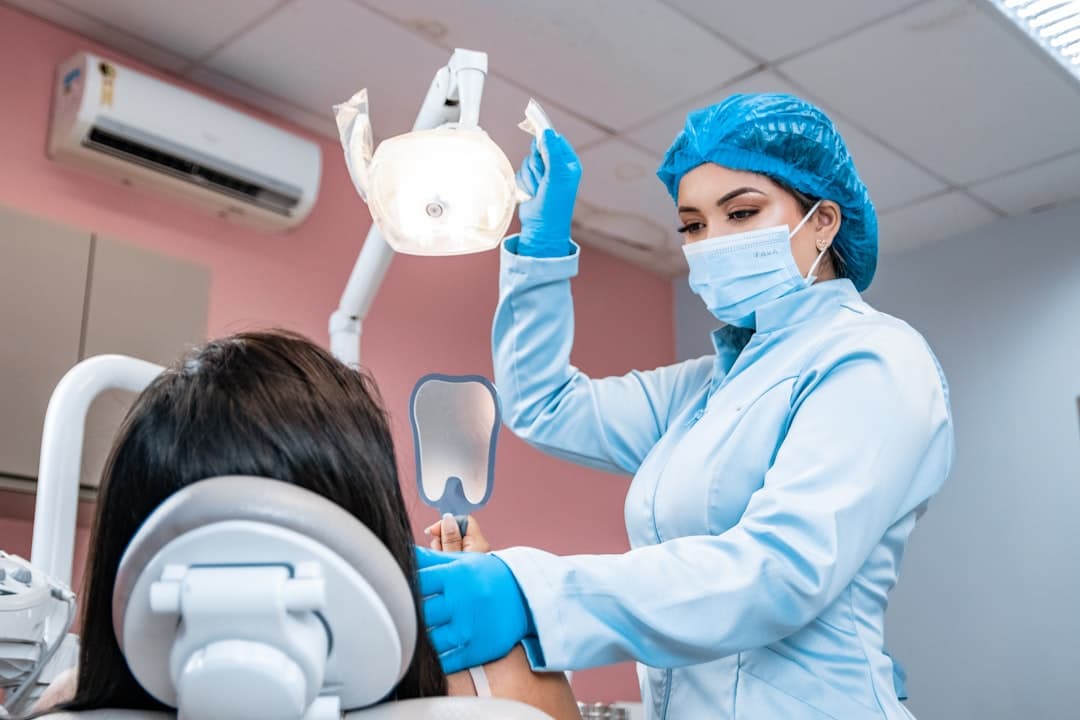
Photo: SoyBreno / Unsplash
Oral surgery documentation, from consult to recovery
Most oral surgery days start with consults. A patient arrives with a panoramic film, an impacted third molar, or a lesion the general dentist wants looked at, and you work through history, exam, and imaging to reach a plan. That plan often carries two coding trails at once. A straightforward extraction is dental (a CDT code), but trauma, cysts, biopsies, and many implant cases are medically necessary and bill as CPT with an ICD-10 diagnosis. The note has to support whichever path applies, sometimes both in one visit.
Then there is the operative work. A note for surgical removal of impacted teeth needs tooth numbers, whether the tooth was soft-tissue or bony impacted, the flap, any sectioning, bone removal, and how the site was closed. If the case was done under IV sedation, the anesthesia record runs on its own clock: pre-op ASA class and airway, the agents and doses, monitoring, and recovery. Getting all of that down by hand, chair after chair, is what pushes charting into the evening.
Transcribe Health listens to the consult or to your narration during and after a case, and drafts a note that puts the detail where it belongs: the tooth, the technique, the sedation, and the post-op instructions. You read it and sign. Nothing is filed without you.
Documentation Challenges in Oral & Maxillofacial Surgery
- 1
Writing operative and extraction notes with the anatomy, tooth numbers, flap design, and bone removal that billing and audit review expect
- 2
Documenting consults that cross dental and medical territory, where the same visit may need a CDT code, a CPT code, and an ICD-10 diagnosis
- 3
Recording IV sedation and general anesthesia detail: agents, doses, monitoring, ASA class, and recovery, on a separate timeline from the surgery itself
How Transcribe Health Helps Oral Surgery
Operative and Extraction Notes
Turns your intra-op narration into a structured note with tooth numbers, flap and sectioning detail, and closure, ready to sign.
Dental and Medical Consults
Captures the history, exam, and imaging read from a consult so you have the diagnosis and plan on the page for both the dental chart and the medical record.
Sedation and Anesthesia Records
Records the agents, doses, ASA class, and monitoring you dictate so the anesthesia record matches the surgical note.
An oral surgery note, captured in real time
An abridged consult for impacted third molars with a planned surgical extraction under IV sedation, drafted the way you would see it before signing.
24-year-old woman referred by her general dentist for evaluation of impacted lower wisdom teeth. Reports recurrent soreness and swelling around the lower left back gum over the past four months, worse in the last two weeks. No fever, no trismus today. Denies chronic medical conditions, takes only an oral contraceptive, no known drug allergies. Nonsmoker. Prior dental work tolerated without problems. Interested in sedation for the procedure.
Well-appearing, no facial asymmetry or lymphadenopathy. Mouth opening within normal limits. Teeth #17 and #32 not clinically visible. Mild erythema and a partial operculum over #17 with tenderness on palpation, no purulent drainage. Panoramic radiograph shows #17 mesioangular and partially bony impacted, root apices clear of the inferior alveolar canal; #32 vertical and soft-tissue impacted. ASA class I.
1) Impacted mandibular third molars #17 (mesioangular, partial bony impaction) and #32 (soft-tissue impaction). 2) Localized pericoronitis at #17. Candidate for surgical removal of both under IV sedation; risks reviewed given proximity of #17 roots to the inferior alveolar nerve.
Surgical extraction of #17 and #32 scheduled under IV moderate sedation. Reviewed risks including bleeding, infection, dry socket, and transient or, rarely, permanent inferior alveolar and lingual nerve paresthesia; consent obtained. Chlorhexidine rinse and a short ibuprofen course for the active pericoronitis until surgery. NPO instructions and an escort arranged for the sedation appointment. Post-op she will get written aftercare and a follow-up in 7 to 10 days for a healing check. Return sooner for uncontrolled pain, swelling, or numbness that does not resolve.
Illustrative example. Not a real patient encounter.
Built for oral surgery coding and your EMR
Oral surgery often carries a dental and a medical coding trail from the same visit. Notes capture the anatomy, the technique, and the medical necessity that support a CPT claim or, on the dental side, a CDT code, plus the ICD-10 diagnosis that ties them together. That detail is the first thing to slip when charting is rushed.
- 99204 / 99205New-patient consult, moderate to high complexity
- 41899Unlisted dentoalveolar procedure, used for surgical removal of impacted teeth billed to medical (paired with the CDT D7220-D7241 series on the dental claim)
- 41830Alveoloplasty or removal of bone or tissue, per quadrant
- 41100Biopsy of tongue, anterior two-thirds
- 41800Incision and drainage of abscess, cyst, or hematoma of dentoalveolar structures
- 21248Reconstruction of mandible or maxilla, endosteal implant, partial
- K01.1Impacted teeth
- K08.1Complete loss of teeth due to accident, extraction, or local periodontal disease
- K09.0Developmental odontogenic cysts
- K12.2Cellulitis and abscess of mouth
- M26.4Malocclusion, unspecified
Fits the workflow you already have
Drafts drop into the systems oral surgery practices run on, including practice-management platforms like Dolphin, DSN Software, and WinOMS, and the hospital EMRs (Epic, Oracle Health) you chart in for OR cases. You get whatever note type you are working in: a consult, an operative report, or a post-op check. It writes up the exam and the imaging read you dictate. It does not interpret radiographs or CBCT scans for you; you read the film and make the call, and it records what you say.
Oral surgery AI scribe questions
Does it understand oral surgery terminology and tooth numbering?
Can it document procedures, or only consults?
How does it handle both dental and medical coding?
How is patient information protected?
Does it connect to our EMR and imaging?
Ready to Transform Your Documentation?
Join thousands of healthcare providers who save hours every day with AI-powered medical transcription.
Start Free Trial