AI Scribe for Optometry
Transcribe Health drafts your exam note while you work the chair, so the acuities, the refraction, and the slit-lamp findings are on the page before the patient stands up.
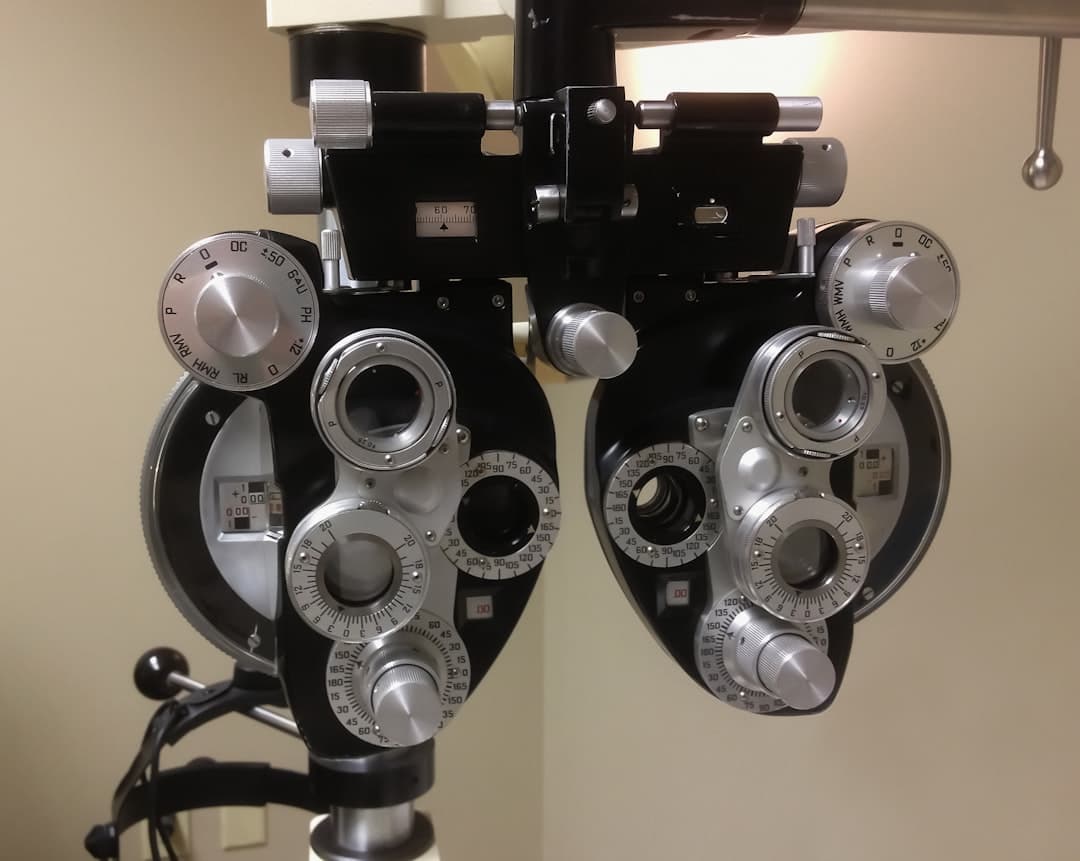
Photo: CDC / Unsplash
Optometry documentation, from the comprehensive exam to the medical visit
A comprehensive eye exam generates a lot of structured data in a short time. Distance and near acuity for each eye, pupils, confrontation fields, extraocular motility, cover test, IOP, the slit-lamp exam of lids, conjunctiva, cornea, anterior chamber, and lens, then the dilated fundus look at the disc, macula, vessels, and periphery. Most of this gets called out at the chair and has to land in the right field for the right eye.
The refraction is its own piece. A manifest refraction of -2.75 -1.25 x 015 with a +2.00 add means nothing if the axis or the add drifts, and a contact lens fitting adds base curve, diameter, power, and the brand you settled on. These are the numbers a tech or a lab reads back, so they have to be exact.
Then there are the visits that are medical, not routine. A patient comes in with a red eye, sudden floaters, or a referral for a diabetic eye exam, and the note has to carry the history, the findings, and the reasoning, not just a screening result. Transcribe Health listens to the encounter and drafts a note that keeps the acuities, the refraction, the slit-lamp and fundus findings, and your assessment in their places. You read it and sign. Nothing files without you.
Documentation Challenges in Optometry
- 1
Capturing a dense grid of structured exam data (visual acuity, IOP, pupils, confrontation fields, extraocular motility, and slit-lamp findings for each eye) in the order the note expects it
- 2
Recording the refraction and any contact lens fitting with the exact sphere, cylinder, axis, add, and lens parameters, where a transposed number changes the prescription
- 3
Separating a routine vision exam from a medical eye visit (red eye, floaters, a diabetic screening) so the note supports the right code and the right level of medical decision-making
How Transcribe Health Helps Optometry
Structured Exam Capture
Files your acuities, IOP, pupils, motility, and slit-lamp findings for OD and OS as you call them out, in the layout your exam note uses.
Refraction and Fitting Notes
Records the manifest refraction, the add, and contact lens parameters as you dictate them, so the numbers land where you expect and read back correctly.
Medical Visit Documentation
Drafts the history and decision-making for a red eye, a diabetic eye exam, or a glaucoma follow-up so the medical piece is documented, not buried.
An optometry note, captured at the chair
An abridged comprehensive exam for a patient with dry eye and an early cataract, drafted the way you would see it before signing.
68-year-old woman here for a routine comprehensive exam. Reports gritty, burning eyes worse by late afternoon and at the computer, using artificial tears about twice a day with partial relief. Notes glare when driving at night and that her current glasses feel a little weak for reading. No pain, no flashes, no new floamers, no diplopia. History of hypertension, no diabetes. Last exam roughly two years ago.
Uncorrected VA 20/40 OD, 20/50 OS at distance. Manifest refraction OD -1.25 -0.50 x 090, OS -1.50 -0.75 x 085, add +2.25, correcting to 20/20 OD and 20/25 OS. Pupils equal, round, reactive, no APD. EOM full, confrontation fields full both eyes. IOP by applanation 15 mmHg OD, 16 mmHg OS. Slit lamp: mild meibomian gland dropout with reduced tear breakup time (about 6 seconds), trace inferior corneal punctate staining both eyes, quiet anterior chambers, 1+ nuclear sclerosis both lenses. Dilated fundus: cup-to-disc 0.3 both eyes, flat maculae, normal vessels, periphery intact.
1) Dry eye disease, evaporative pattern with mild meibomian gland dysfunction, both eyes. 2) Early nuclear sclerotic cataract, both eyes, mild, not yet visually limiting beyond refractive change. 3) Refractive error, myopia with presbyopia, updated. 4) Hypertension, stable, no retinopathy.
Updated spectacle prescription given with the new add. Start warm compresses and lid hygiene twice daily, increase preservative-free artificial tears to four times daily, and add an omega-3 supplement. Discussed that the cataract is early and does not need surgery now; will monitor. Counseled that reduced night driving glare is expected with the new lenses. Return in one year for comprehensive exam, sooner if the dryness or vision worsens.
Illustrative example. Not a real patient encounter.
Built for optometry coding and your EHR
Notes capture the exam elements, the history, and the medical decision-making that decide between an eye visit code and an E/M level, and that support any imaging or field testing you ran. That is the detail a payer looks for, and the first thing to slip when the chart is written after hours.
- 92004Comprehensive eye exam, new patient, one or more visits
- 92014Comprehensive eye exam, established patient, one or more visits
- 99204 / 99214E/M visit, new or established, for a medical eye complaint
- 92083Visual field examination, extended (threshold perimetry)
- 92134OCT of the retina, unilateral or bilateral
- 92250Fundus photography with interpretation and report
- H52.4Presbyopia
- H25.11Age-related nuclear cataract, right eye
- H04.123Dry eye syndrome, bilateral lacrimal glands
- E11.319Type 2 diabetes mellitus with unspecified diabetic retinopathy without macular edema
- H40.011Preglaucoma, open angle with borderline findings, low risk, right eye
Fits the workflow you already have
Drafts drop into the systems optometry practices run on, including RevolutionEHR, Crystal PM, Eyefinity, and Compulink, plus the general EHRs a co-located medical group uses. You get whatever note type you are in, a comprehensive exam, a contact lens fitting, or a medical follow-up. It writes up the refraction, the slit-lamp exam, and the fundus findings you dictate. It does not read your OCT, fundus camera, or visual field output; it records the interpretation you give of them.
Optometry AI scribe questions
Does it handle refraction and exam values without garbling them?
Can it tell a routine vision exam from a medical eye visit?
Does it document contact lens fittings?
How is patient information protected?
Does it connect to our EHR and imaging?
Ready to Transform Your Documentation?
Join thousands of healthcare providers who save hours every day with AI-powered medical transcription.
Start Free Trial