AI Scribe for General Dentistry
Transcribe Health drafts your exam findings, procedure notes, and treatment plans while you work, so the tooth-by-tooth detail is charted before you move to the next operatory.
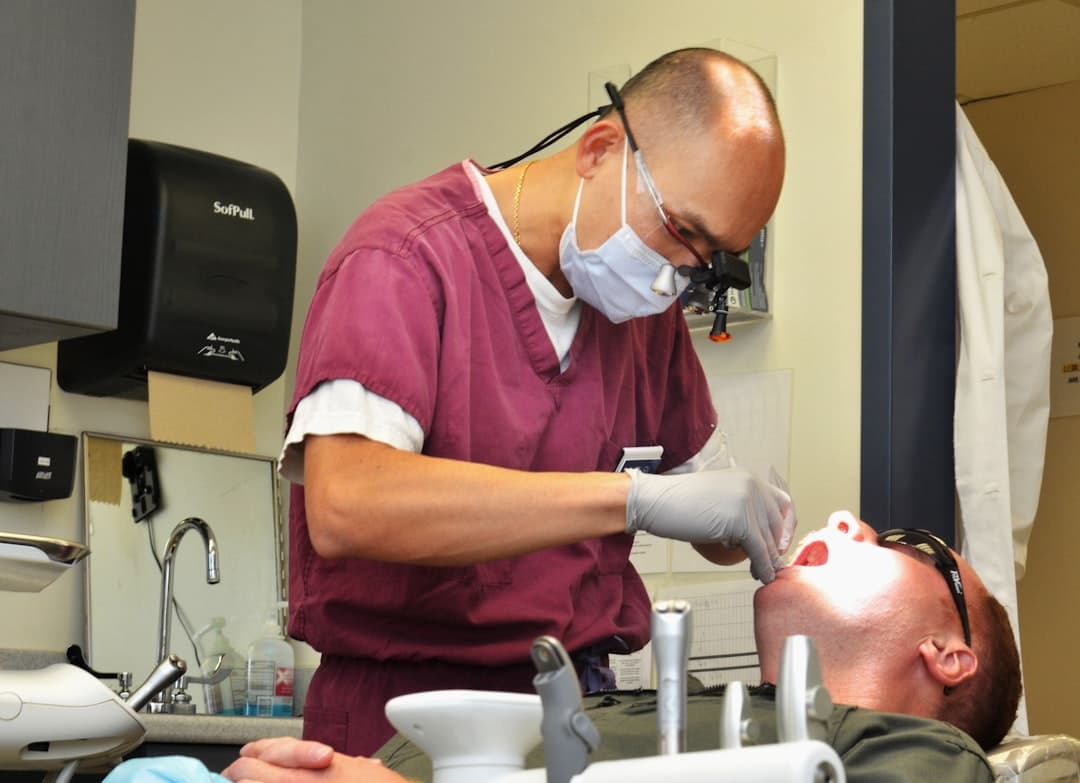
Photo: Navy Medicine / Unsplash
Dental documentation, from the exam to the treatment plan
A comprehensive exam produces a lot of small facts that all have to land in the right place. You move through the mouth calling out existing restorations, new caries by tooth and surface, cracks, wear, and soft-tissue findings. The hygienist runs six probing depths per tooth plus recession and bleeding points. Radiographs get read. By the time you sit down to chart, some of it is already fading, and the odontogram only helps if what you saw actually made it in.
Procedure notes carry their own detail. A single-visit composite on tooth #14 needs the surfaces (say, MOD), the anesthetic and amount, isolation, the bonding step, the material and shade, and the occlusal check. A crown prep, an extraction, a build-up, and root planing each have their own required elements, and a thin note is the one an auditor or a payer flags.
Transcribe Health listens to the exam or to your narration after a procedure and drafts a note that puts each finding where it belongs: tooth numbers, surfaces, probing depths, materials, and the reasoning behind the plan you recommended. You read it, correct anything, and sign. Nothing is filed without you.
Documentation Challenges in General Dentistry
- 1
Charting findings tooth by tooth, surface by surface, along with six-point periodontal probing depths, recession, bleeding on probing, and mobility for a full mouth
- 2
Writing clinical notes with your hands in the patient's mouth, so charting waits until the procedure is over and detail gets lost
- 3
Building a sequenced treatment plan and matching each item to the right CDT code so the note supports what you submit to the payer
How Transcribe Health Helps General Dentistry
Exam and Charting Notes
Takes what you call out during the exam, existing restorations, caries by surface, perio probing depths, and drafts it into the odontogram note and the periodontal chart summary.
Procedure Notes
Structures the record for a composite, crown prep, extraction, or scaling from your narration: tooth number, surfaces, anesthetic, material, and shade.
Treatment Plan Documentation
Records the phased plan you discuss with the patient and pairs each recommended procedure with its CDT code so the note and the estimate line up.
A dental note, captured in real time
An abridged new-patient comprehensive exam, drafted the way you would see it before signing.
43-year-old woman, new patient, last dental visit roughly two years ago. Chief complaint is sensitivity to cold on the upper right and occasional food impaction between the lower left molars. No pain at rest. Reports she brushes twice daily and flosses a few times a week. Medical history reviewed: no known drug allergies, takes lisinopril for hypertension, no bleeding disorders.
Extraoral exam unremarkable, no lymphadenopathy or TMJ tenderness. Intraoral soft tissues within normal limits, oral cancer screening negative. Full-mouth series of 18 radiographs taken and reviewed. Hard-tissue findings: caries on tooth #3 occlusal, tooth #14 mesio-occlusal-distal (MOD), and tooth #19 distal. Existing amalgam on #30 occlusal, intact. Recurrent decay under the distal margin of #18 crown. Periodontal charting: generalized probing depths 2 to 3 mm, localized 4 to 5 mm pockets on #18, #19, and #31 with bleeding on probing. Mild recession on #24 and #25. Localized moderate calculus on the mandibular anterior lingual. No mobility noted.
1) Dental caries: #3 (O), #14 (MOD), #19 (D), and recurrent caries at #18. 2) Localized moderate chronic periodontitis, mandibular molars, with bleeding on probing. 3) Generalized mild gingivitis. 4) Cold sensitivity on the upper right, consistent with the #3 lesion. Overall risk: moderate caries risk, moderate periodontal risk.
Reviewed findings with the patient using the radiographs and intraoral photos. Phase 1: scaling and root planing for the affected quadrants, followed by a re-evaluation in 4 to 6 weeks. Phase 2: composite restorations on #3 (O), #14 (MOD), and #19 (D); evaluate #18 crown margin for a possible crown replacement once the recurrent decay is fully assessed. Prophylaxis and fluoride varnish today. Reviewed home care, recommended daily flossing and a prescription-strength fluoride toothpaste. Recall in 6 months, or sooner if periodontal re-evaluation calls for a shorter interval. Cost estimate provided for each phase before treatment.
Illustrative example. Not a real patient encounter.
Built for dental coding and your practice software
Dental claims run on CDT codes (the D-code set maintained by the ADA), not CPT, and a clean chart note is what supports each one. A comprehensive oral evaluation is D0150, a full-mouth series is D0210, and an adult prophylaxis is D1110. A single-surface posterior composite is D2391, and the MOD restoration in the sample note above is a three-surface posterior composite, D2393. Scaling and root planing is coded per quadrant (D4341 for four or more teeth, D4342 for one to three). The note has to show the tooth number, the surfaces, and the clinical reason the work was needed, because that is exactly the detail a payer asks for when a claim is questioned. Transcribe Health drafts the note with those elements in place; you confirm the code that matches.
Fits the practice-management software you already run
Drafts drop into the systems most practices chart in: Dentrix, Eaglesoft, and Open Dental, along with cloud platforms like Curve Dental and tab32. You get the note in the format you work in, an exam write-up, a procedure note, or a treatment-plan summary, and you paste or sync it into the patient record. It writes up the perio depths, surfaces, and materials you dictate. It does not draw on your odontogram for you or read radiographs; you make the clinical call and it records what you say.
General dentistry AI scribe questions
Does it understand dental terminology and tooth numbering?
Can it document procedures, or only exams?
Does it help with CDT codes and treatment plans?
How is patient information protected?
Does it connect to our practice-management software?
Ready to Transform Your Documentation?
Join thousands of healthcare providers who save hours every day with AI-powered medical transcription.
Start Free Trial