
From Ambient to Agentic: How AI Scribes Are Starting to Do More Than Document
AI scribes are moving from passively transcribing visits to drafting orders, referrals, and follow-ups. Here is what agentic documentation means for clinicians and where the guardrails sit.

By Fatih Aktas, Founder & CEO
Published

The scribe is becoming a coworker, not just a stenographer
For the last few years, the pitch for AI scribes was simple: stop typing, start listening. The tool sat quietly in the room, captured the conversation, and produced a note you reviewed and signed. That is ambient documentation, and it already saves clinicians real time.
In 2026 the frontier moved. The same models that draft a clean SOAP note can also read that note and propose the next actions: the lab order implied by the assessment, the referral letter the plan calls for, the patient instructions, the follow-up appointment. This is the shift from ambient to agentic. The scribe stops being a transcriptionist and starts behaving like a junior team member who drafts the busywork and hands it back for your approval.
It is a meaningful change, and it is worth understanding clearly before it shows up in your workflow, because the upside and the risk both grow at the same time.
What "agentic" actually means here
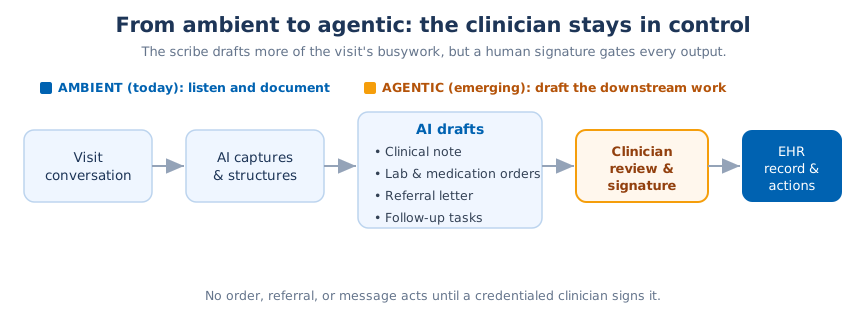
The word "agent" gets stretched to the point of meaninglessness in marketing. In the context of clinical documentation, an agentic scribe does three things a passive scribe does not:
- It takes actions, not just text. Instead of only writing "order CBC and CMP," it can pre-populate those orders in the EHR as drafts ready for a signature.
- It chains steps. A single encounter can produce a note, a coding suggestion, a referral draft, and a patient summary, with each step building on the last.
- It works across the visit boundary. Pre-charting from the chart and recent results before you walk in, then closing the loop with follow-up tasks after you walk out.
The critical word in all of that is draft. A responsible agentic scribe proposes. The clinician disposes. Nothing reaches an order queue, a pharmacy, or another provider without a human deciding it should.
Where it helps most
The visits that benefit are the ones drowning in downstream paperwork, not the ones with complex reasoning.
Referral-heavy specialties. A dermatologist flagging a suspicious lesion, a primary care physician sending a patient to cardiology, an orthopedist routing to physical therapy. The referral letter is predictable from the encounter, and drafting it automatically removes a task that usually waits until the end of the day.
Chronic disease management. A diabetes follow-up implies a familiar bundle: HbA1c, lipid panel, foot exam reminder, medication refills. An agentic scribe can assemble that bundle as drafts so the clinician confirms rather than builds from scratch.
Care transitions. Discharge instructions, follow-up scheduling, and the message to the primary care provider are exactly the kind of structured, repetitive output that benefits from a first draft generated straight from the visit.
The common thread: the AI is good at the predictable connective tissue around a decision. It is not making the decision. The physician still decides whether the referral is warranted or the lab is indicated.
Where the guardrails have to be
Agentic capability raises the stakes because the output is no longer just words on a page that a clinician reads. It can be an action that propagates. A hallucinated sentence in a note is a problem the reviewing clinician catches. A hallucinated medication order is a patient safety event if it slips through. The safeguards have to scale with the capability.
Three principles separate a safe agentic scribe from a reckless one:
- Human approval is non-negotiable and unbypassable. Every order, referral, and outbound message is a draft until a credentialed clinician signs it. There is no "auto-send" mode for clinical actions, and there should not be one.
- Every proposed action traces back to the encounter. When the scribe suggests a lab, you should be able to see the part of the conversation or chart that justifies it. Actions without provenance are guesses dressed up as recommendations.
- Scope is bounded and configurable. The practice decides what the agent is allowed to draft. A clinic might enable referral letters and patient summaries but keep medication orders entirely manual until they trust the workflow.
These are not features to take on faith. They are questions to ask any vendor selling "agentic" documentation: Can the agent ever act without a human signature? Can I see why it proposed each action? Can I turn individual capabilities off?
The liability question gets sharper
We have written before about how responsibility for AI-generated notes still rests with the signing clinician. Agentic workflows do not change that principle, but they do raise the cost of a rubber-stamp review.
When the scribe only wrote a note, a careless review risked an inaccurate record. When the scribe drafts orders, a careless review risks an inappropriate order. The discipline that already matters with ambient notes - actually reading what you sign - becomes more important, not less, as the tool does more.
The practices that adopt this well treat the agent's output as they would a draft from a new resident: useful, time-saving, and always checked before it counts. The ones that get into trouble will be the ones who let convenience erode review.
What to expect over the next year
Agentic documentation is early. Most clinicians using AI scribes today are still firmly in ambient territory, and that is fine. The note-taking time savings alone justify adoption.
But the direction is set. Over the coming year, expect the boundary between "documentation tool" and "clinical workflow assistant" to keep blurring. The move that ages well: adopt ambient documentation now, get comfortable with the review discipline it demands, and switch on agentic capabilities deliberately, one at a time, as you earn trust in each.
Done responsibly, agentic scribes pull the clinician further out of the clerical work that surrounds the decision without ever touching the decision itself. Done carelessly, they automate the wrong thing.
Transcribe Health builds documentation that keeps the clinician in control: every note and every proposed action is a draft you review and sign. See how it works or try it free.
This article is for informational purposes only and does not constitute clinical, legal, or compliance advice. AI-generated documentation and any AI-proposed clinical action must always be reviewed and approved by the responsible provider before being entered into the medical record or acted upon.
Related Articles
AI Medical Scribe Comparison 2026: A Side-by-Side Look at the Leading Tools
A factual, side-by-side comparison of the leading AI medical scribe platforms in 2026, pricing, EHR integration, specialty depth, compliance, and where each one actually fits.
AI TechnologyBest AI Medical Scribe Software in 2026: How to Choose
A practical guide to evaluating AI medical scribe platforms in 2026, covering the features, questions, and trial strategies that actually matter.
AI TechnologyAI Medical Scribe Integration with EHR Systems
How AI medical scribes integrate with EHR systems like Epic, Cerner, and athenahealth to streamline clinical documentation workflows.
Ready to Try AI-Powered Documentation?
Join thousands of healthcare providers saving hours every day with Transcribe Health.
Start Free Trial